


What is the Kubernetes Gateway API?
The Gateway API is a modern standard for service networking in Kubernetes. It isn't just a "better Ingress"-it is a complete rethink of how traffic, security, and routing should be managed.
Managed by the Kubernetes SIG-NETWORK community, it provides a standardized way to manage load balancing, points of entry, and traffic routing.
Why CTOs and Engineers are Switching
1. Role-Oriented Design (No More Bottlenecks)
In the old Ingress model, the platform team and the development team often stepped on each other's toes. The Gateway API is built for the way modern US engineering teams actually work:
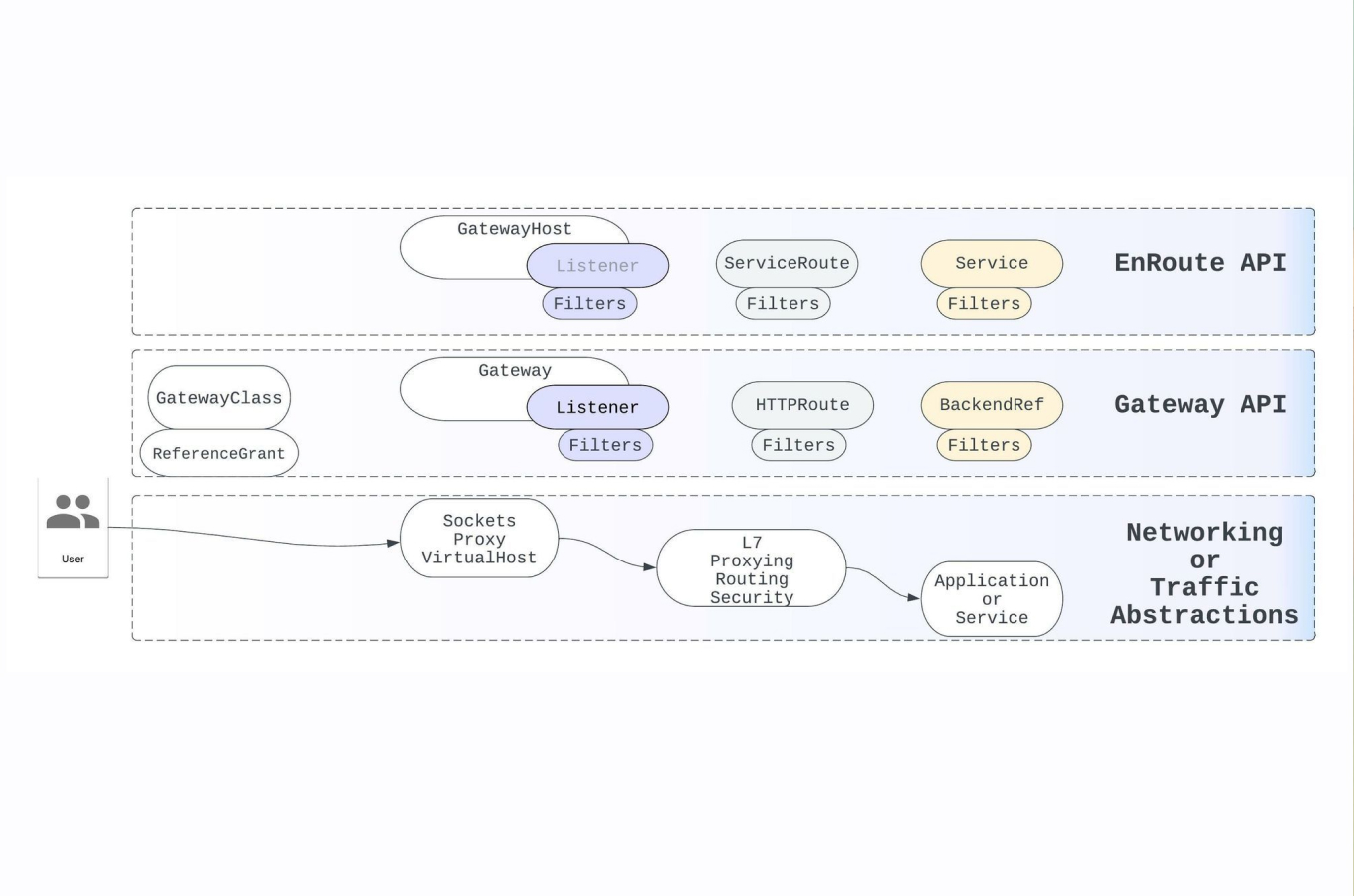
- Infrastructure Providers manage the GatewayClass (the engine).
- Cluster Operators manage the Gateway (the entry point and security).
- Developers manage the HTTPRoute (how their specific app receives traffic).
This separation means your developers can deploy changes to routing without needing cluster-wide permissions, speeding up your CI/CD pipeline.
2. Native Features, Not "Annotations"
If you’ve ever used Ingress, you know the pain of using vendor-specific annotations for things like header-based routing or SSL redirects. These are hard to maintain and impossible to migrate. The Gateway API brings these features into the core specification. It is expressive and portable.
3. Built for Multi-Tenancy
For companies running large-scale operations, the Gateway API allows a single Gateway to securely route traffic to services across different namespaces. This reduces infrastructure costs and simplifies your networking architecture.
Gateway API vs. API Gateway: What’s the Difference?
It’s easy to get confused by the names.
- Gateway API is the specification or the language used within Kubernetes.
- An API Gateway is the tool (like Envoy or Istio) that performs the actual work-handling authentication, rate limiting, and traffic flow.
The Gateway API provides a standard way to configure these tools, ensuring you aren't locked into a single vendor.
How Saaras Simplifies Your Transition
Implementing the Gateway API can be daunting. Between managing Envoy Proxies and ensuring FIPS compliance or Istio configurations, your team can lose weeks to "plumbing" instead of building features.
Saaras bridges this gap. We help US-based engineering teams:
- Modernize Ingress: Move from legacy Ingress controllers to Gateway API-based solutions like Envoy Gateway without the headache.
- Enhance Security: Implement robust security policies and observability at the networking layer.
- Scale Efficiently: Ensure your networking stack is optimized for performance and cost, whether you are on AWS, GCP, or Azure.
The Bottom Line
The Gateway API is no longer "the future"-it is the present. For CTOs aiming for a scalable, secure, and developer-friendly infrastructure, moving to the Gateway API is the logical next step.

Not immediately, but eventually. While Ingress is still supported and functional for simple use cases, it has reached "feature complete" status, meaning no new capabilities are being added. The Gateway API is the designated successor, designed to handle the complex requirements (like blue-green deployments and header-based routing) that Ingress can only manage through clunky, vendor-specific annotations.
Yes. Most modern controllers (like Envoy Gateway or Istio) allow you to run both side-by-side in the same cluster. This allows for a "canary" migration strategy where you move services over to the Gateway API one by one without a high-risk "big bang" cutover.
No. One of its primary goals is portability. Because the API is a standardized specification, you can move your HTTPRoute configurations from an EKS cluster on AWS to a GKE cluster on Google Cloud with minimal changes, provided both environments use a Gateway API-compatible controller.No. One of its primary goals is portability. Because the API is a standardized specification, you can move your HTTPRoute configurations from an EKS cluster on AWS to a GKE cluster on Google Cloud with minimal changes, provided both environments use a Gateway API-compatible controller.