


The Foundation: What is FIPS 140?
FIPS 140 is a series of standards issued by NIST that coordinate the requirements and standards for cryptographic modules. It ensures that the "engines" performing your encryption are secure, tested, and reliable.
The challenge for modern DevOps teams is that FIPS isn't a "set it and forget it" feature. It exists in levels:
- Level 1: Software-only encryption with no physical security requirements.
- Level 2: Adds requirements for physical tamper-evidence and role-based authentication.
While your cloud provider (like AWS or Azure) likely handles FIPS at the hardware and OS level, the data-in-transit within your Kubernetes clusters is often your responsibility.
The Maintenance Burden: Why DIY FIPS Fails
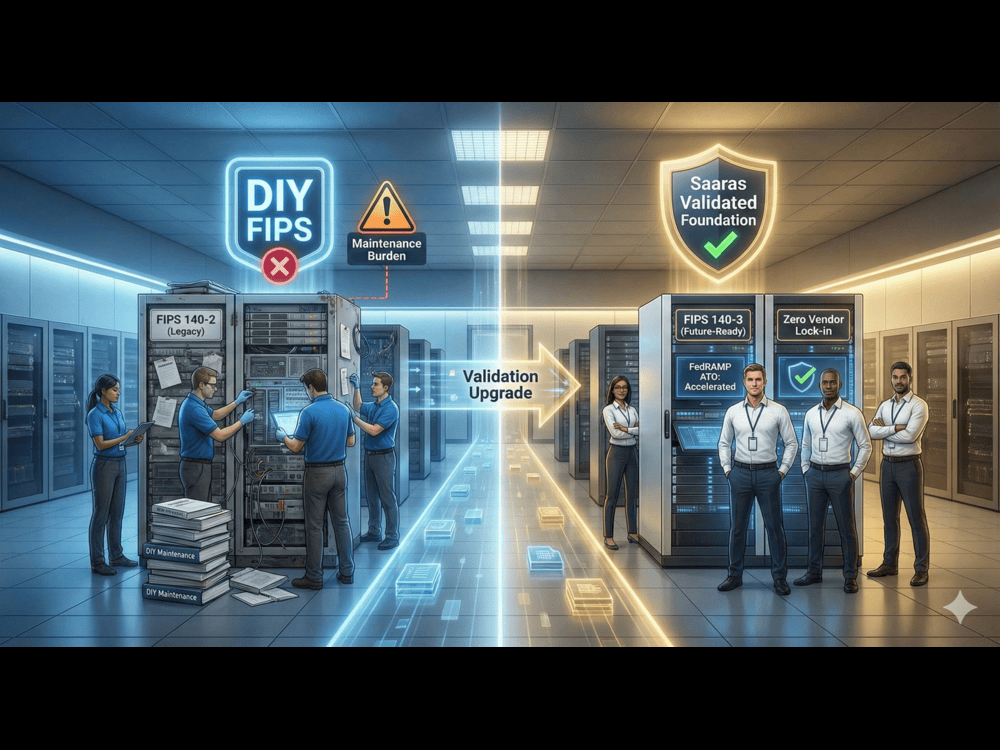
Many engineering teams try to build their own FIPS-validated stack by recompiling Envoy or Istio against validated BoringCrypto modules. While this works in theory, the long-term maintenance is a nightmare.
Every time a CVE is released, your team must:
- Patch the source code.
- Recompile against the validated module.
- Ensure the build process itself doesn't invalidate the FIPS status.
- Re-verify performance, as FIPS modules can introduce significant latency.
This "FIPS tax" drains your best engineers' time and slows down your product roadmap.
Accelerating Your Path with Saaras
This is why we built the Saaras Istio FIPS Subscription. We provide a drop-in, production-ready distribution of Istio that is fully FIPS 140-2 validated and ready for the FIPS 140-3 transition.
By offloading the maintenance of your FIPS 140-2 Validated Service Mesh to Saaras, you get:
- Audit-Ready Binaries: Stop worrying about whether your crypto modules will pass the 3PAO assessment.
- Performance Optimization: Our builds are tuned to minimize the latency overhead often associated with FIPS encryption.
- Zero Vendor Lock-in: We use 100% upstream-compatible Istio. You keep your existing configurations and tools; we just provide the hardened, validated core.
Conclusion
FIPS 140 compliance shouldn't be a barrier to innovation. By choosing a validated foundation for your service mesh, you can stop focusing on cryptographic libraries and start focusing on winning federal contracts.
Ready to simplify your compliance journey?
Explore how the Saaras Istio FIPS Subscription can shorten your FedRAMP timeline today.

FIPS 140-3 is the newest iteration of the standard, aligned more closely with international ISO/IEC standards. While FIPS 140-2 is still widely accepted, FIPS 140-3 introduces more rigorous testing requirements, improved security for diagnostic interfaces, and updated integrity techniques. Organizations aiming for FedRAMP or FISMA must prepare for the mandatory transition to 140-3 as older 140-2 certificates eventually reach their sunset dates.
Only partially. While providers like AWS, Azure, and Google Cloud offer FIPS-validated hardware and operating systems, they operate under a Shared Responsibility Model. You are responsible for the security of everything insideyour environment, including the data-in-transit within your Kubernetes clusters and the service mesh (like Istio) you use to manage it
Level 1: Software-only encryption with no physical security requirements. Level 2: Adds requirements for physical tamper-evidence and role-based authentication. Levels 3 & 4: Higher tiers of physical security and intrusion resistance, typically reserved for specialized hardware.
Saaras provides pre-built, audit-ready binaries that are already FIPS 140-2 validated. This eliminates the months of engineering work required to build and maintain a custom FIPS-hardened service mesh. It ensures that when a 3PAO (Third-Party Assessment Organization) audits your networking layer, your cryptographic modules are already verified and documented.