


The Evolution: From Ingress to Gateway API
Before we dive into EnRoute’s enhancements, let’s understand the fundamental shift from Ingress to Gateway API.
Standard Kubernetes Ingress: A Good Start, But Lacking Depth
Ingress was designed to be a simple HTTP/S router. It allows you to define rules for external access to services within your cluster, primarily based on hostnames and paths.
Pros of Standard Ingress:
- Simplicity: Easy to get started with basic HTTP/S routing.
- Widespread Adoption: Many controllers available (Nginx, HAProxy, etc.).
- Basic Load Balancing: Supports simple round-robin load balancing.
Cons of Standard Ingress:
- Limited Capabilities: Lacks advanced traffic management features like weighted load balancing, traffic splitting, header-based routing, and circuit breakers.
- Vendor-Specific Annotations: Many advanced features required vendor-specific annotations, leading to configuration sprawl and lack of portability.
- Role-Based Access Control (RBAC) Challenges: Difficult to delegate responsibilities to different teams (e.g., app developers vs. platform engineers).
- Protocol Limitations: Primarily focused on HTTP/S, with limited support for other protocols like TCP/UDP.
- No Policy Enforcement: Doesn't inherently support defining and enforcing security or traffic policies at a granular level.
Kubernetes Gateway API: The Next Generation of Traffic Management
The Gateway API was developed to address the shortcomings of Ingress, providing a more expressive, extensible, and role-oriented approach to traffic management.
Key Concepts of Gateway API:
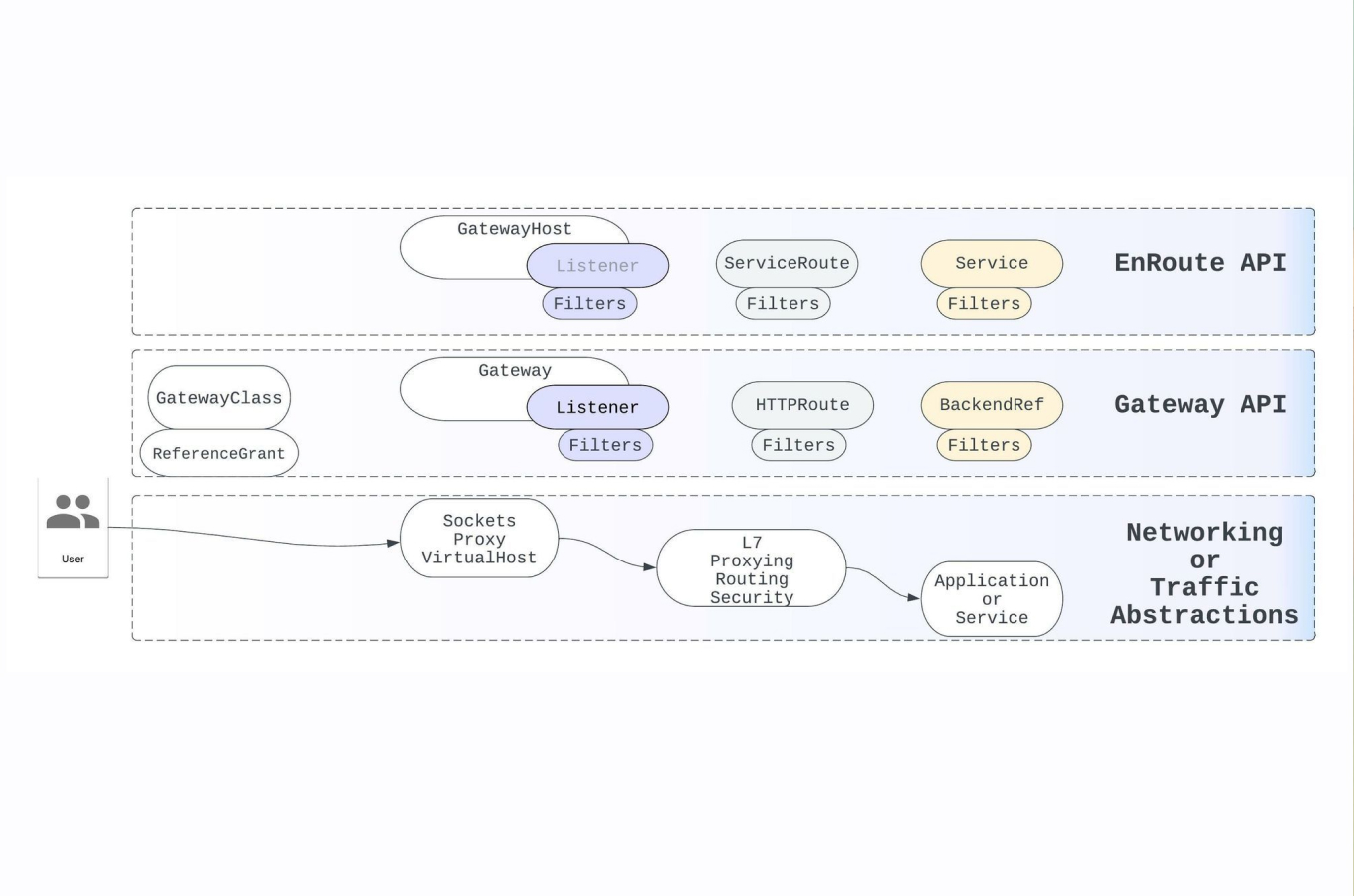
- GatewayClass: Defines a class of Gateways and allows for implementation-specific configuration.
- Gateway: Represents a specific traffic entry point into the cluster (e.g., a load balancer, proxy). It defines listeners (ports, protocols) and can be managed by platform operators.
- HTTPRoute/TLSRoute/TCPRoute/UDPRoute: Define rules for routing traffic to backend services. These are meant for application developers and allow for much more granular control.
Benefits of Gateway API:
- Rich Expressiveness: Natively supports advanced routing features like weighted load balancing, header/query parameter matching, traffic mirroring, and more.
- Role-Oriented Design: Clearly separates concerns, allowing platform operators to manage Gateways and application developers to define routes.
- Protocol Agnostic: Supports HTTP, HTTPS, TCP, TLS Passthrough, and UDP, making it suitable for a wider range of applications.
- Extensibility: Designed for easy extension with custom filters and policies.
- Standardized Policies: Provides a more consistent way to apply policies across different implementations.
Gateway API: Elevating Traffic Management
EnRoute Gateway API is a powerful, production-ready implementation that leverages the full potential of the Gateway API, providing a robust, performant, and feature-rich solution for modern Kubernetes environments.
Gateway API Improves on Standard Ingress (and even the basic Gateway API):
- Comprehensive Advanced Traffic Management:
- Beyond Basic Routing: This includes fine-grained traffic splitting for A/B testing and canary deployments, weighted load balancing for controlled rollouts, and advanced header/query parameter-based routing for precise traffic steering.
- Resilience Features: Implement circuit breakers to prevent cascading failures, retries for transient errors, and health checks to ensure traffic only goes to healthy instances – features largely absent or complex to configure with standard Ingress.
- Request/Response Transformations: Modify headers, body, or path of requests and responses on the fly, enabling seamless integration with legacy systems or API versioning without changing application code.
- Enhanced Security and API Management:
- Native Authentication & Authorization: Integrated support for various authentication mechanisms (JWT, OAuth2, basic auth) and can enforce fine-grained authorization policies directly at the edge, reducing the burden on application developers. Standard Ingress typically relies on external solutions or requires complex annotations.
- Rate Limiting & Throttling: Protect your backend services from abuse and ensure fair usage with powerful global or per-route rate limiting capabilities, crucial for API monetization and stability.
- Web Application Firewall (WAF): Integration with WAF capabilities to protect against common web vulnerabilities and malicious attacks, providing an additional layer of security that Ingress simply doesn't offer.
- Observability and Monitoring:
- Deep Metrics and Tracing: Extensive metrics (latency, error rates, throughput) out-of-the-box, easily integrated with Prometheus and Grafana. It also supports distributed tracing (e.g., with Jaeger), giving you unparalleled visibility into your traffic flow – a significant upgrade from the basic logging of Ingress controllers.
- Access Logging: Configurable and detailed access logs provide invaluable insights for debugging, auditing, and security analysis.
- Simplified Operations and Developer Experience:
- Clear Role Separation: Platform teams manage the Gateway deployment and define the Gateway resource, ensuring operational consistency. Application teams then define HTTPRoutes for their services, empowering them with self-service routing while adhering to platform policies.
- Centralized Policy Management: Define policies (like rate limiting or authentication) once and apply them across multiple routes or services, reducing configuration duplication and improving maintainability. This is a stark contrast to the disparate annotation hell of Ingress.
- Multi-Protocol Support: Beyond HTTP/S, support for TCP and TLS Passthrough via the TLSRouteand TCPRoute resources, making it a versatile solution for a wider range of services, including databases or message queues.
Conclusion: Why Gateway API is the Future
While Kubernetes Ingress served its purpose, the demands of modern cloud-native applications necessitate a more robust, flexible, and powerful traffic management solution. The Kubernetes Gateway API is that solution, and EnRoute supports the lates Gateway API standard, it stands out as a leading implementation that not only fulfills but exceeds these requirements.
By offering comprehensive advanced traffic management, enhanced security, deep observability, and a superior developer and operator experience, the Gateway API implementation enables organizations to build more resilient, scalable, and secure applications in Kubernetes.
If you're looking to future-proof your Kubernetes traffic management, move beyond the limitations of Ingress, and empower your teams with a truly modern API Gateway, exploring EnRoute Gateway API is your next logical step. It's not just an upgrade; it's a paradigm shift towards intelligent, efficient, and secure traffic control in the cloud-native era.

The primary difference lies in expressiveness and role separation. Ingress is a single resource that handles basic HTTP routing, often requiring "annotation hacks" for advanced features. The Gateway API is a collection of resources (GatewayClass, Gateway, HTTPRoute) designed to separate the concerns of infrastructure providers, cluster operators, and application developers.
Absolutely. While standard Ingress is almost exclusively focused on HTTP/S (Layer 7), EnRoute leverages the Gateway API to support TCP, UDP, and TLS passthrough. This makes it ideal for non-web workloads like databases (PostgreSQL/MySQL), mail servers, or IoT message brokers.
t depends on your use case. EnRoute provides many "mesh-like" features at the edge-such as retries, circuit breaking, and mTLS—without the overhead of sidecars. For many organizations, EnRoute provides enough north-south traffic control that a full East-West service mesh (like Istio or Linkerd) becomes unnecessary.